How does the Cape Dory 36 perform offshore?
I had a brief off shore sail in Gypsy Wind from South Carolina to Florida. Hopefully, I will have some opportunities to do some serious off shore passages before I age out. The clock IS ticking.
The following is a segment of a review that was posted by Erin Anne, a member of the Cape Dory group on Facebook.
How does the Cape Dory 36 perform offshore?
Last month we arrived in St Thomas after our 3rd offshore trip on Bertha. We have now logged over 10,000 nm in open ocean. We have encountered pretty much everything from days of windless conditions to gales with 40 knots of wind and 30 ft waves in the Atlantic Ocean.
We had no idea how a Cape Dory 36 would perform offshore when we first left 3 years ago. We read and researched all we could but there wasn’t really a lot written on a Cape Dory 36 in offshore conditions.
We thought that sharing some of our thoughts, opinions and experiences might be valuable to this group.
Seaworthiness
Heavy Wind/Waves
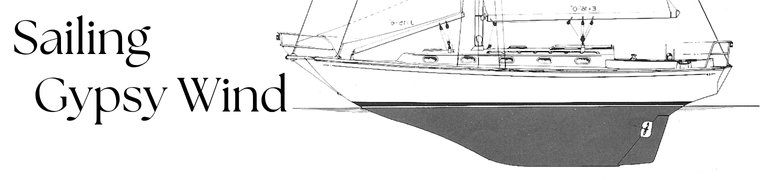
To be on a full keel, cutter rigged boat in heavy seas and gale force winds is an awe-inspiring experience. The sometimes terrifying low free board, allows her to slip between and down the seas, using that big fat keel to steadily manage monster waves. Presenting such little windage in gales that is so effortless, you feel strangely safe in conditions that are telling your brain that this is not OK. Hours being at the helm, sliding up and down waves the size of a house, you come to love this boat in a way that you cannot imagine. She is taking care of you, if you can manage to not do something stupid, the boat will keep you safe.
The low free board definitely makes the Cape Dory 36 a “wet boat”. We were not totally sure of what that meant when we read the reviews. I will be more specific, at any heel greater than 15 degrees the toe rail is underwater and the bow is diving under waves. Waves are slapping over the sides and hitting the dodger. Anything on the sides of the deck are going to eventually get washed over, no matter how well you try to secure them. You have water running down the deck at a volume that is coming into the cockpit. You are WET and so is everything else. Thus- we keep the heel less than 15 degrees as much as possible.
Sailing
We can generally keep 5-6 knots over ground in almost any wind above 10 knots and any point of sail, with a steady 6-7 knots when the winds are off the quarter and above 15 knots. For distance planning we use approximately 120-140 nm/day as our estimated daily range depending on conditions. We have been as low as 60 nm or as high as 150 km on the trips we have taken.
Depending on sea conditions we tend to keep full sails up to just under 20 knots. We prefer a more comfortable sail and will spill wind or douse sails to keep the heel to under the 15 degrees, even if it costs a bit of speed. Often the goal is really to avoid having to hand steer the helm- meaning we set sails to be able to allow the Hydrovane or autopilot to hold the helm. This last trip we lost both the Hydrovane and the autopilot for the last 1,000 km and had to hand steer. It was brutal. Never. Again.
Over 20 knots we start by dropping or reefing the yankee- unless downwind when we use a wing on wing sail plan with the yankee in the whisker pole. Upwind and to the beam as winds climb we go from a main and staysail to various reefed versions of either.
At 30 knots or more we usually have 2reefs in the main and the stay sail out. As the winds approach 35 knots the main is gone staysail is reefed. At 40 knots we have everything down and use the stack pack as the “3rd reef” or storm sail equivalent.
The Cape Dory 36’s ability to track or hold course while upwind around 20 degrees is so outstanding you barely have to touch the helm, let alone how well it will hold with auto pilot or Hydrovane when they are set. Downwind is messier for the Hydrovane and autopilot, the full keel makes either have to swing a bit to hold course. If the waves are really big- you are hand steering to prevent jibes.
For light winds we pole out the asymmetrical spinnaker. Once Bertha gets her big butt moving, we can sail at 5 knots in 5 knots of wind!